
Transformation PMO MODUS X: How We Enabled Resilience, Scale, and Innovation at DTEK
Business
One hryvnia invested in Ukrainian IT creates another 1.09 hryvnias across other sectors of the economy. One IT specialist supports another 2.29 jobs in adjacent industries. These figures come from the Code Economy 2025 study – the first attempt to comprehensively measure the structural footprint that technology leaves on the country's economy.
The study was prepared by the analytics company DataDriven, commissioned by the IT Ukraine Association, in partnership with UKRSIBBANK BNP Paribas Group, Kyivstar.Tech and MODUS X, and with the support of the Ministry of Digital Transformation. For us, taking part in it is a chance to look at our own work more broadly – not as isolated digitalisation projects, but as a contribution to the resilience of entire industries.
As of 2025, the industry employs over 305,000 specialists across 2,243 companies. The total market volume is $7.85 billion, of which $1.25 billion comes from the domestic market. IT accounts for 3.2% of GDP, delivers $6.6 billion in exports (41.6% of the country's entire services export) and remains one of the main contributors to the budget – UAH 50.5 billion in taxes a year.
Exports are stable but highly concentrated: around 80% of revenue comes from just 10 countries. The key markets are Europe (51%, or $3.39 billion) and the United States (36%, or $2.4 billion).
The most interesting part begins beyond IT itself. Every hryvnia in the industry pulls another 1.09 hryvnias through the economy, and every specialist supports 2.29 jobs in adjacent fields. Together that adds up to more than 800,000 direct and indirect jobs. In effect, IT works as a multiplier: money and expertise spread across the entire cross-industry chain.
The full-scale invasion became a brutal stress test – and, at the same time, an unexpected accelerator. High-IT industries (those with high IT intensity) grew by +19.9%, while less digitalised sectors grew by only +4.7%. Companies that had been through more cycles of digital transformation before 2022 kept production running even after losing physical infrastructure: digital assets proved more mobile than material ones.
The researchers also quantified the cost of delay. Had traditional sectors reached the High-IT level before the invasion, the economy could have preserved around UAH 166 billion. Every additional 1% spent on IT before the war would have meant 0.48% less lost added value after it.
Code Economy breaks the effect down by sector:
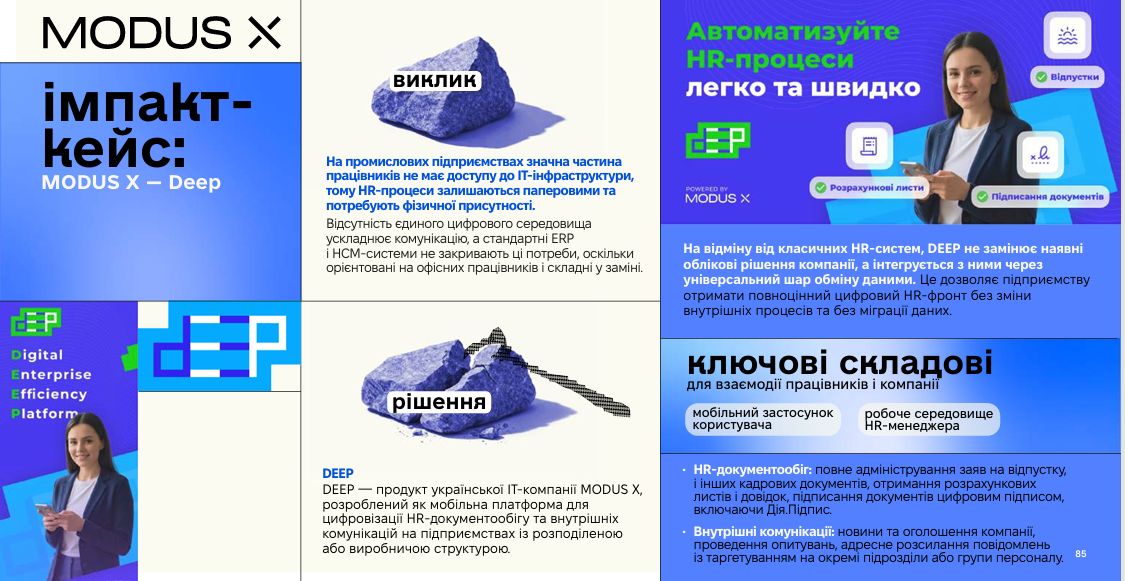
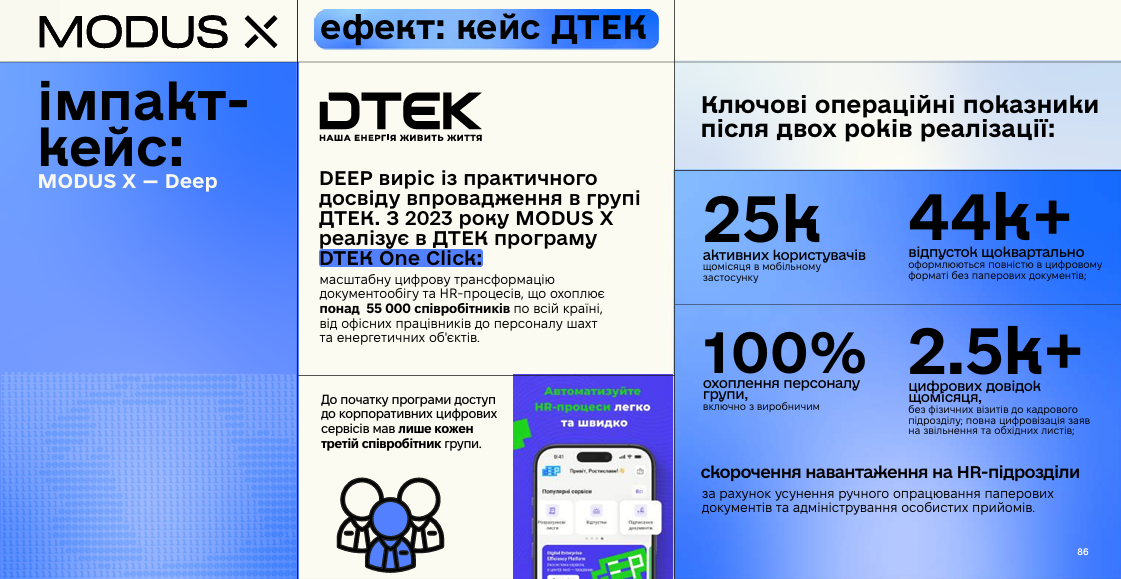
Code Economy features a separate MODUS X impact case: DEEP – a product that lets you automate the HR function easily and quickly. It's a digital HR platform that turns routine personnel processes into a convenient app for the employee. Since 2023, MODUS X has been rolling out DEEP across DTEK Group – one of the country's largest energy ecosystems – and over two years the solution has scaled to tens of thousands of users and delivered a tangible operational effect.
It's a clear illustration of the study's central conclusion: a digital product becomes the infrastructure on which a business holds firm and grows.
The level of digitalisation directly determines how quickly an economy – and an individual company – recovers, scales and competes. The study puts it plainly: IT is not a separate industry but the infrastructure of long-term resilience and growth.
That's the very logic MODUS X works by. We help large businesses and the energy sector go through digital transformation – from IT infrastructure and cloud services to cybersecurity and ERP.
Code Economy 2025 shifts the conversation about IT from "a support cost" to strategy. An industry that delivers 3.2% of GDP and $6.6 billion in exports also works as a multiplier for the whole economy – and it's the level of digitalisation that determines who recovers faster and pulls ahead.
For business, the takeaway is practical: investing in technology is a way to make a company more resilient. And it's easier to start that journey with a partner who has already walked it at scale.
📎 The full Code Economy 2025 study is available on the IT Ukraine Association website.