MVP Definition Technique
Talent X
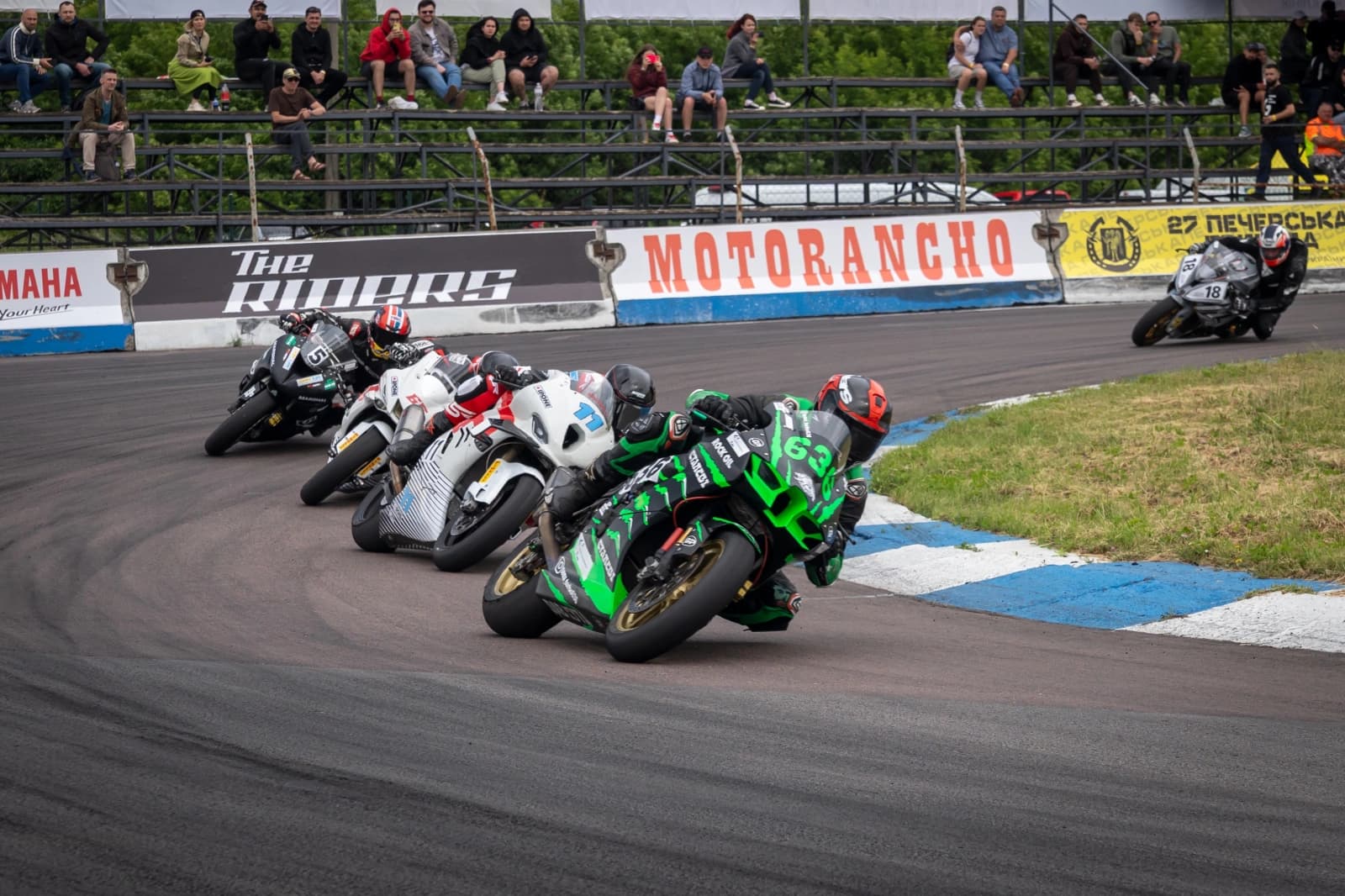
Our QA Engineer Artem Chumachenko took third place at the first round of the 2026 Ukrainian Road Racing Championship (Superbike class). And yet, this year he hadn't even planned to line up at the start. In the end, Artem earned bronze after a single practice session, a rain-soaked qualifying that he won, and a race he rode through back pain.
This year, Artem wasn't planning to enter the championship — purely for financial reasons. But his friends and sponsors began urging him on: "Come on, let's race." It was decided literally at the last moment.
His preparation was minimal. At the Chaika circuit, where the race was held, Artem rode his own bike for just one practice session — on Saturday, the day before the Sunday race. He was even short on tyres: he bought a new rear only just before the round, while the front was left over from last season. To put it in perspective, that single rear tyre survived 26 laps in one day — practice, qualifying and the race — even though a set normally lasts for just one outing.
The key drama unfolded in qualifying, which sets your grid position based on your fastest lap. The moment Artem went out, it started to rain. And the tyres in this class are slicks — completely smooth, like in Formula 1: on a wet track, grip almost disappears. Everyone had started on "dry" tyres, since no rain was expected, and qualifying isn't postponed — it lasts only 15 minutes.
Artem made a risky call: while the rain was still light, ride as fast as possible. On the third lap, in one of the corners, his rear wheel began to slide at around 100 km/h — but he caught it and held the bike. The gamble paid off: Artem won qualifying with the fastest time of any rider and lined up from pole position.


The stewards declared the race "wet," so each rider chose their own tyre type. Artem bet on slicks, counting on the track drying out — and he got it right. But he botched the start: in its most cautious setting, launch control choked the power too much, and in the first few metres around six or seven rivals went past him.
From there, Artem began reeling the positions back in. By the second lap he was up to third, and on the third lap he moved into the lead. The fight was tight, with several overtakes. The only thing holding him back was a long-standing back problem: before the race the medics gave him a painkilling injection, but by the end of the race riding had become very hard. Even so, Artem finished third — on the podium.
There were 18 riders in his class, and on his way to the finish he even lapped two backmarkers who had fallen more than a lap behind. And all of this on a Kawasaki Ninja ZX-10R, a far cheaper machine than those of his top rivals. Colleagues from MODUS X came to Chaika to cheer Artem on.
The season has only just begun: three more rounds lie ahead. The champion is decided on points across at least four rounds, so the battle will run until the end of the year. The next round — a double-header, with two races over two days — is scheduled for the middle of next month. Artem is doing everything he can to make the grid.
How long have you been in motorsport?
— I made my debut in the 2018 finale, and then rode full seasons in 2019, 2020 and 2021. I started in the amateur class, and later moved up to Superstock — a semi-professional level. Last year I competed in two classes at once — both Superstock and Superbike — but in Superbike the competition is too strong; there's even a fourteen-time Ukrainian champion there, and I'm not yet at their level. So this year, weighing up the budget and common sense, I'm racing only Superstock, where the rivals are roughly on my level. Over my career I've had around five podiums, and I haven't climbed higher than third place so far.
In 2021 you had a serious crash. What happened, and how quickly did you come back?
— I suffered eight fractures. But just two months later I was back competing. That season could have brought more podiums, but the crash got in the way.
You're a QA engineer by profession. Does that meticulous attention to detail help you on the track?
— Directly. My bike has telemetry — I record the logs and analyse the data: each lap time, the racing line, the bike's parameters. Essentially, it's the same work with quality and detail as in the profession: you study the numbers and look for where you can find another fraction of a second. Without that kind of analysis, it's very hard to progress.
How fast is your bike, and can it be pushed even further?
— Overall, the bike is capable of around 300 km/h. But top speed isn't the main thing: by adjusting the sprockets you can trade outright top end for quicker acceleration. In racing, acceleration matters more, because it's what cuts your lap time. So I deliberately lower the top speed for the sake of dynamics.
Why do we hear so little about motorcycle racing in Ukraine?
— Unfortunately, there's a lack of marketing and organisation, and because of the war, interest in sport in general has dropped. For comparison: in 2018 we had a TV broadcast and around three thousand spectators in the stands, whereas now, at best, seven hundred turn up. So the riders are trying to develop everything on their own.
Are there Ukrainians competing abroad?
— Yes, and very strong ones. My former teammate Nikita Kalinin is the only Ukrainian to have raced in the World Championship, and he even scored a podium there — which is extraordinarily hard to do. Illia Mykhalchyk is a three-time German champion; last year he became British champion, and this year he moved up to a stronger class — British Superbike. People just don't know much about them.
What keeps you in this sport despite the costs, the risk and the injuries?
— When you live for it, the fear is gone. I go out onto the track at speed and I'm not afraid — on the contrary, I'm thinking about how to ride even faster. That's exactly what's so addictive.
We congratulate Artem on third place and wish him success in the rest of the season!