Corporate Email Has Become a Gateway to the Employer. And You Have Not Given It to Everyone...
Paperless Office

An electrician works at a substation a hundred kilometres from the office. To take leave, he agrees the dates with his supervisor, waits for someone to cover his shift, travels to the city on his day off and fills out a handwritten request. From there, the request takes on a life of its own: it sits with HR, waits for approval from a senior manager, comes back, is turned into an order, printed, signed, filed and entered into the company’s records system. During that time, the employee calls HR twice to ask whether everything is on track.
According to Deloitte’s estimates, for every 1,000 employees, a company wastes around UAH 1.5 million on this kind of bureaucracy each year. HR teams spend 57% of their time on administrative tasks.
The worst part is that most companies have already automated this process. And almost nothing has changed.
A typical mistake looks like this. A company takes a process that evolved over 20 years and has not been reviewed in a long time, then carefully transfers it onto a screen. The leave request becomes a PDF form. The folder containing administrative orders becomes a shared drive. The email asking for approval remains an email asking for approval, except now it is sent via Teams.
The workflow itself remains manual. The employee still does not know who currently has their request. The HR administrator still manually transfers dates from the form into the records system. HR still spends half the day answering the question, “When will the order be issued?”
An electronic form is still just a piece of paper. You simply cannot see it.
The difference between a digital form and a digital process comes down to one detail: who decides where the document goes next. If a person is still doing that job, you have not automated anything. You have only changed the medium.
In DEEP, an employee opens the app, selects the type of leave and the dates, and taps “Submit for approval”. They do not choose the approver. The system knows the organisational structure and automatically determines whether approval from the employee’s direct manager is sufficient or whether a more senior manager is required.
The manager receives a push notification and makes the decision in their app. Once approved, the request is sent directly to the records system, where the administrative order is created. If the document requires signatures, DEEP generates it using the request data. The employee and the manager sign it in the app, and the signed document triggers the processing of the order and the calculation of holiday pay.
Things become even more interesting when the company maintains an annual leave schedule. In that case, the employee does not submit a request at all. The app automatically creates one based on the schedule and sends a notification: “Here is your planned leave. Confirm it or change the dates.” The HR team no longer needs to remind anyone.
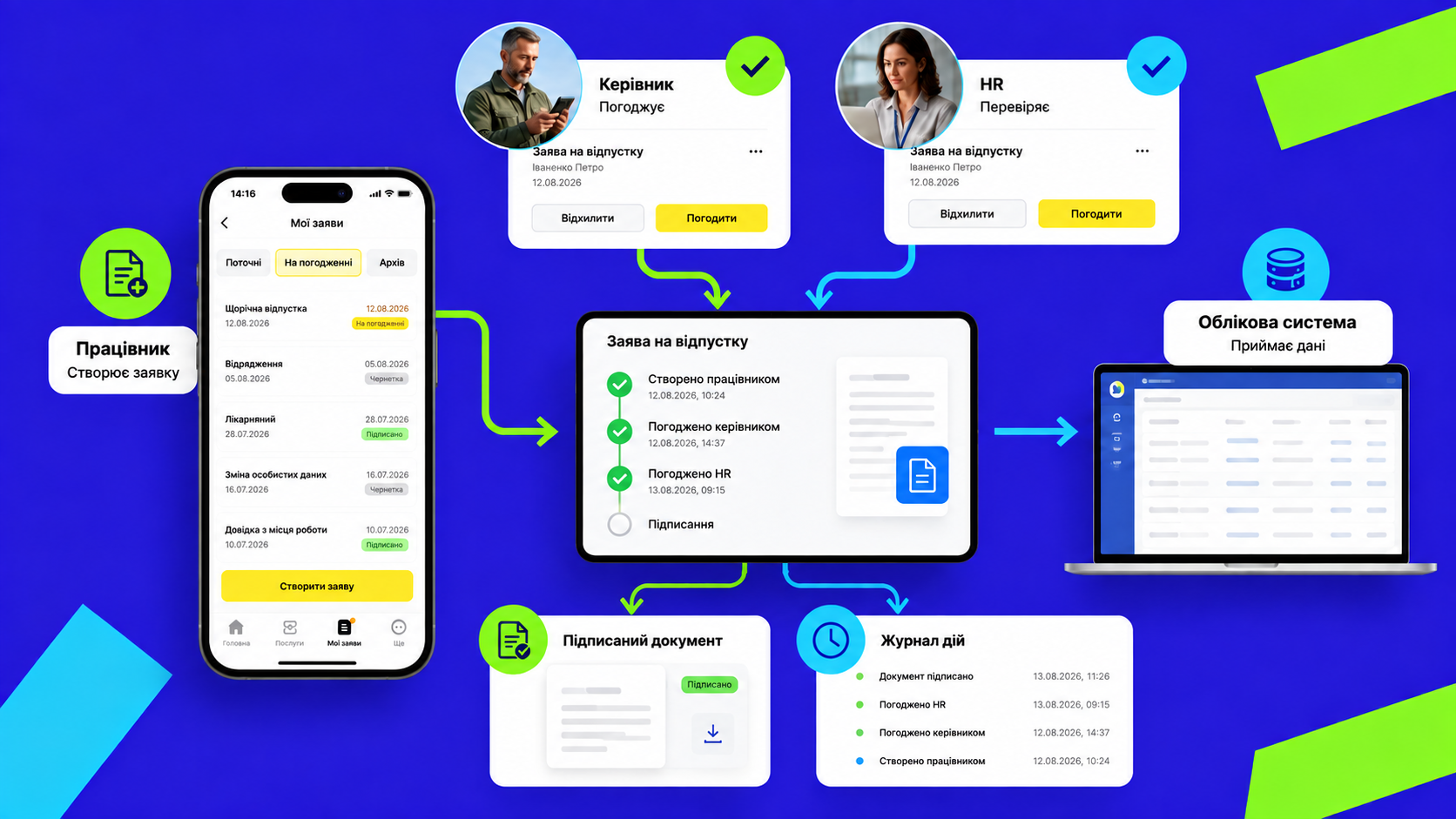
The system takes care of repetitive tasks: retrieving data from the records system, determining the workflow, sending notifications, displaying the status and passing approved data to the next stage.
The manager decides on the leave dates. HR configures the approval rules and handles exceptions, of which there are always plenty in a large company. Legal teams define the requirements for signatures and document retention.
This is not a formality. It is a clear boundary of responsibility. A product that promises “automated approvals” is promising something that will not, and should not, happen.
HR digitalisation projects usually fail not at the integration stage, but at adoption. And not because of resistance, but because of two very practical issues.
The employee does not have a digital signature. Not everyone has Diia.Signature, especially older employees in operational roles. One solution that, for some reason, is rarely discussed is that the bank managing the company’s payroll project can usually issue employees with personal digital certificates, either automatically or at the company’s request. These certificates can be used to sign HR documents in the same way as Diia.Signature.
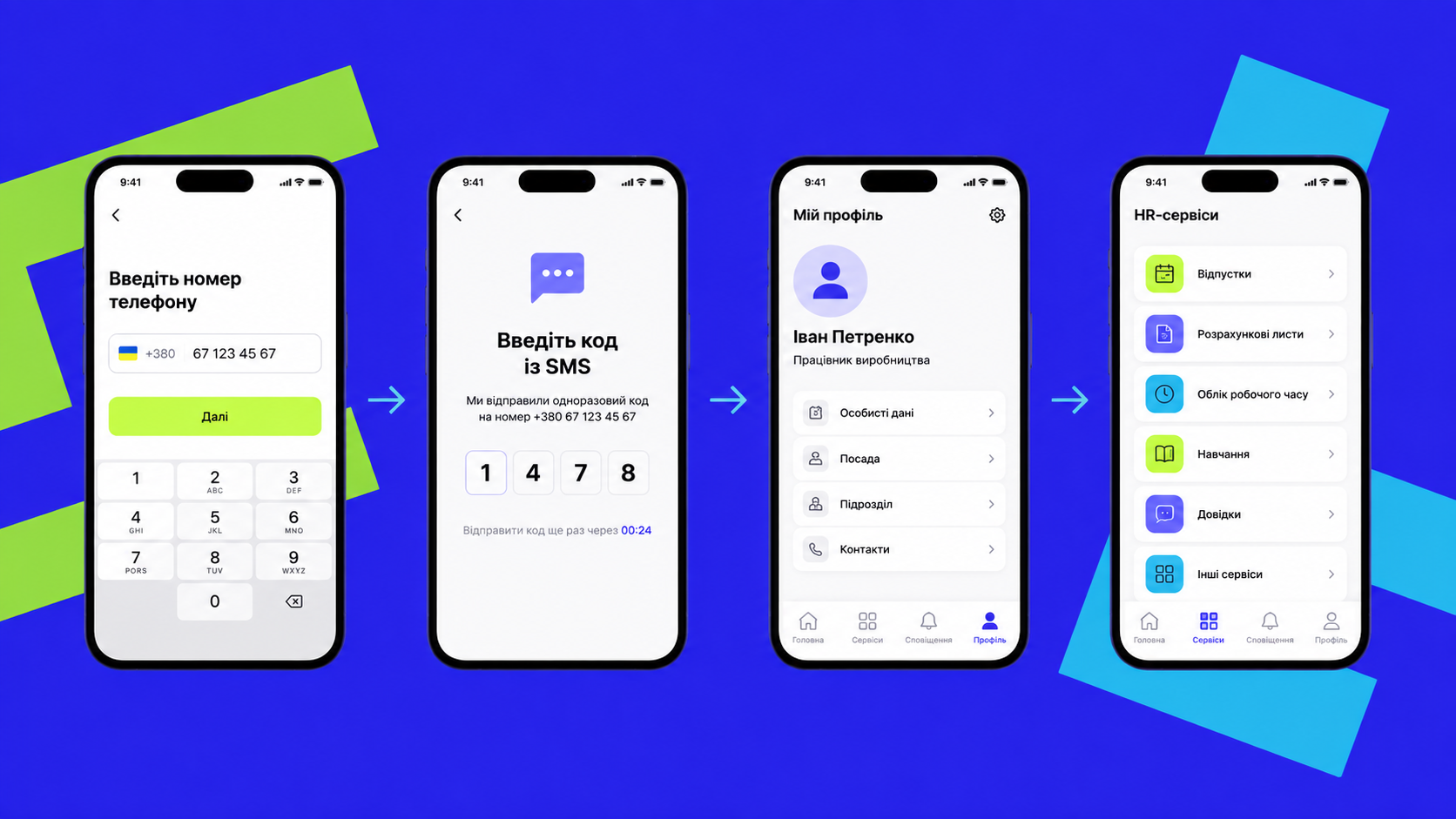
The employee does not have a smartphone at all. One shared device with the app installed can be provided for the entire crew. Each employee signs in using their phone number, confirms their identity with a one-time code, completes the required action and signs out
There is no separate registration step. The employee’s data and position within the organisational structure come from the records system, so they only need to download the app and enter the phone number already recorded in the HR system. No corporate email address is required.
A separate point worth addressing is financial data, as this is usually the first concern raised by information security teams. Payslips are not stored in the app. A payslip can only be opened once, and if an employee chooses to save it, that is a deliberate action involving their own document.
Access to the approval service is protected by a second authentication factor or Face ID. Employee data cannot be exported in bulk without super administrator permissions, and each service receives only the exact amount of data required for a specific operation. The architecture was designed with GDPR requirements in mind.
Creating a leave request in an app does not in itself make it legally valid. The company must first approve the rules governing electronic HR document management, including the list of documents, the workflow, the type of signature, the method of notifying employees, and where and for how long the documents will be stored.
The legal framework is set by the Law of Ukraine “On Electronic Documents and Electronic Document Management” and the Law of Ukraine “On Electronic Identification and Electronic Trust Services”. In DEEP, documents are signed using qualified electronic signatures of both individuals and legal entities through Diia.Signature or the government service id.gov.ua, which supports signatures issued by most Ukrainian trust service providers.
It is also important to remember the requirement under the Law of Ukraine “On Leave” to notify an employee in writing of the start date of their leave no later than two weeks in advance. This routine requirement is often breached unnoticed in paper-based processes, while the system handles it automatically.
HR records remain in the system you already use, whether it is SAP, ERP or HRM. DEEP automates the exchange of documents between employees and that system.
The organisational structure, positions, leave balances and access permissions are automatically updated from the HR system every day. New employees gain access automatically, while employees who leave the company automatically lose it, with no IT requests required. Documents are exchanged via a dedicated API for each service, while the level of automation depends on how far you are prepared to go on the HR system side.
As DEEP is a SaaS solution, implementation comes down to configuring the daily data import and setting up the integration on your side using ready-made instructions. The average connection time is three weeks.
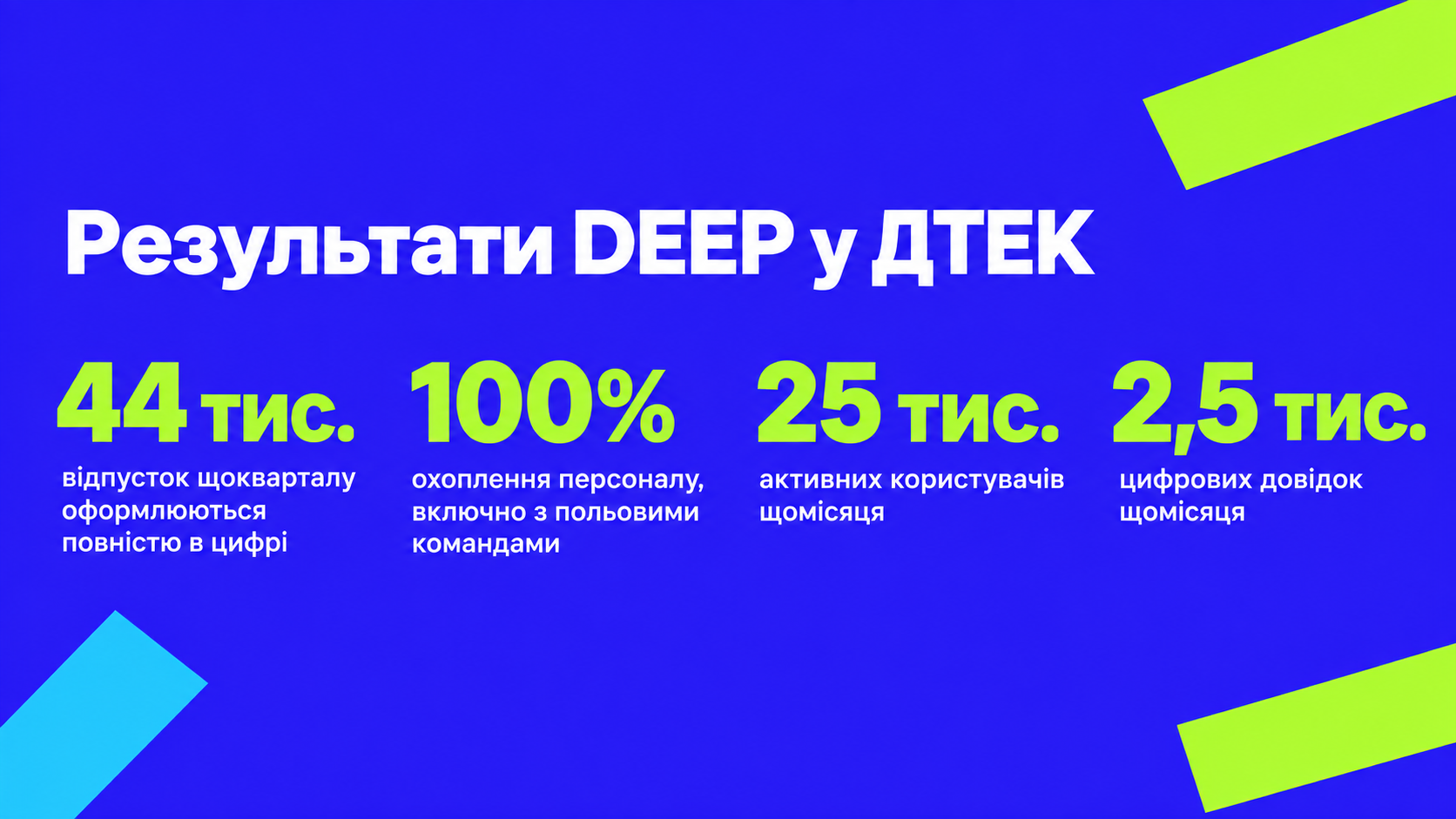
100% workforce coverage, including production and field teams without a digital workplace. Around 25,000 active users every month. A total of 44,000 leave requests are processed entirely digitally every quarter, without a single paper document. Some 2,500 certificates are issued every month without employees having to visit HR. The HR team saves 15–20 hours a week on routine requests.
Resignation requests and clearance forms have also gone digital, but that is a topic for another conversation.
Walk through your current process from start to finish and answer these questions honestly:
If you do not have an answer to the fifth question, start there. It is the one that will determine the fate of the project.
Is a leave request submitted through the app legally valid?
The request itself is just that - a request. Legal validity comes from the signed document and the company’s approved rules for electronic HR document management.
Does every employee need a qualified electronic signature?
It depends on the document. Some stages of the workflow can be completed through in-app approval without a signature. Where a signature is required, employees can use Diia.Signature or a certificate issued by the company’s payroll bank.
Does it work without a corporate email address?
Yes. Employees sign in using the phone number stored in the HR system and a one-time code.
Do we need to replace our HR system?
No. DEEP works on top of SAP, ERP or HRM systems and exchanges data with them via API.
How long does implementation take?
About three weeks, including the configuration of daily data imports and integration with the HR system.
The MODUS X team will map your leave workflow based on your roles, approvers and HR systems, and show you how much the current process costs in hours and hryvnias.
Calculate the impact: https://deep.modusx.digital